Inquiry-Based Learning as a Dialectical Strategy (Paper)
Logic & Dialectics are misappropriated in the Common Core
*This is a prematurity to further papers on dialectics (originally written 11/18/25)
Introduction
Inquiry-Based Learning (IBL) is a pedagogical strategy involving an ostensibly simple ‘question-and-answer’ format in a controlled environment (Wolpert-Gawron). As simple as it may appear, IBL is meticulously planned and attitudinally maintained in the classroom with an equally dialectical as logical influence. This paper will argue that while the logical aspect of IBL has been studied in some detail over recent years, the converse dialectical is lacking. I will then conclude with a comparison between IBL and Domain 3 of the Danielson Framework (Danielson, p. 59-83) and, finally, a few anecdotes on how I might personally use IBL in both logical and dialectical iterations in a hypothetical 8th grade Common Core aligned classroom.
Inquiry-Based Learning (IBL) Defined
As a strategy for teaching critical thinking, IBL has much in common with the famous ‘Socratic Method’. There, the ‘question-and-answer’ format is stressed as a way to simultaneously come to new conceptual understanding, or to show the futility of reaching for any Absolute definition of concepts. IBL attempts to streamline this process: ‘conceptual understanding’ is not only the understanding of the concept ‘piety’, for example, but the process of reaching ‘the understanding of piety’ as well, the controlled transference of authority from teacher to student (Wolpert-Gawron). This means that an interest in the process and/or the content is not enough; students must be interested in both process/content and the ground of metacognition (‘thinking about thinking’) (ibid.). Moreover, where the Socratic Method places an emphasis on critical thinking often reserved for older or more cognitively advanced students, IBL may be applied to students of any age so long as care is taken to recognize student intellectual capacity.
For these reasons, IBL emphasizes that not only students be interested in the content/process of any specific topic employed in any IBL utilization, but that teachers are as well (ibid.). This presents a difficulty: in a world increasingly dependent on logical and factual understanding over spontaneity and conceptual relationship, it is one thing to steer a classroom of students into finding something generally interesting to the entire class– another to maintain one’s own interest class after class, moment after moment. Recognizing the logic of evolution only takes the mind so far. The remainder of this paper will focus on one approach to this difficulty and will then briefly attempt to apply it practically.
Dialectics Defined
Historically, the term ‘dialectics’ is not exactly the most refined. Since the start of the Age of Reason around the Seventeenth Century, dialectics has generally been gradually shuffled out for its more easily practically applied ‘logic’, a progression unfortunately a bit beyond the scope of the present paper. For brevity’s sake, I define dialectics as the ‘back-and-forth’ of thought necessary to come to new thought, a sentiment found in Plato (p. 934-938), Aristotle (p. 839-847, 865-871), and Hegel (p. 104-111). Underlying this process is the interaction of two-dimensional opposites (fig. 1); as every concept has an opposite, I can only come to understanding a new concept if I can find something in opposition to it, even if only in abstraction (ibid., p. 67-70; Jung, p. 6, 65, 418-420, 420-434; etc.).
As much of what we know regarding the origins of the Socratic Method comes from Plato, this process happens generally ‘subconsciously’ (Plato, p. 940-941; etc.). The Socratic method attempts to bring it to the fore but can only do so insofar as the mind retains interest– in other words, only insofar as the concept may be opposed to something other than itself (Hegel, p. 124; etc.). But the ‘something’, in pure dialectical processing, can be just about anything, a difficulty supervened upon by its potential opposition to logical composition (Aristotle, p. 110-115; Chalmers 34-38), and so canceled out once it reaches full consciousness (Jung, p. 231-233)[1]. IBL, conversely, singles out this ‘process towards consciousness’ as a relativizing (outlining) factor, particularly in the context of the immersive quality of teaching-aid materials such as the Danielson Framework or the Common Core.
So, how does one maintain interest in a simultaneously logical and dialectical conscious-subconscious progression[2]? Logically, an emphasis on factual reasoning and ‘proof’ as evidence of result, rather than of concept/process, simplifies the subconscious material and presents it as potentially conscious for subsequent conscious-to-conscious (student-to-student, person-to-person, teacher-to-student, etc.) allocation and/or objective application. But humans are not merely logical creatures: we ‘think’ in terms of what is ‘certain’ (i.e. what is logical) equally as in terms of what is ‘uncertain’ (i.e. what is dialectical). As such, a brief exposition on the nature of dialectics in the application of IBL is warranted.
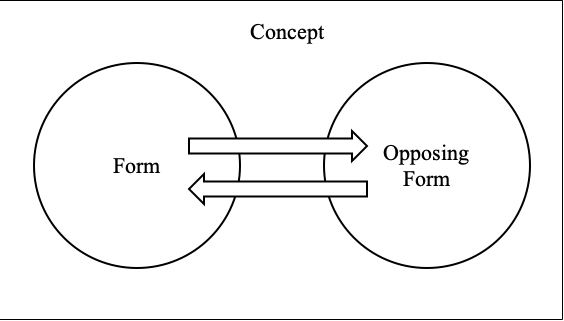
Figure 1
Logic/Dialectics in American Pedagogy
In many ways, the ‘back-and-forth’ of the ‘question-and-answer’ format originating with Socrates/Plato in the West is the foundation of American pedagogy. The American founders had a large respect for ancient philosophy, not only that of the Greek tradition, but of the Asian and the Vedic traditions as well (Small). The role of Socrates in Plato as consciously pedagogical, however, is not so simple.
In IBL, the teacher leads the class in discussion with the goal of merging conceptual/progressive understanding with a focused form of metacognition (Wolpert-Gawron). The ‘thinking about thinking’ is consistent with the content within the context of a logical/dialectical progression; the discussion is equally ‘spontaneous’ as it is evidence-based, equally ‘uncertain’ as it is ‘certain’. This foments several important aspects of IBL, such as versatility of thought (Melber & Hunter, 2010a) and the relation of symbolism across cultures (Melber & Hunter, 2010b). Insofar as pedagogy is intended to instigate thinking of the type applicable to the ‘real world’, these aspects, as contained to their more logical counterparts (as relevant circa 2025), remain integral to the evolution of the subconscious.
However, as the ‘uncertainty’ of the ‘real world’ is as important as its ‘certainty’ in both logical and dialectical systemizations (Magrini, p. 1331-1335), the interaction of concepts on a dialectically focused subconscious-conscious level could elevate IBL or related methods more easily to that of the ‘proficient’ level of several components of Domain 3 of the Danielson Framework. The following, final section details this alignment and briefly introduces a sort of hypothetical ‘logico-dialectical’ method for its aid. On a personal level, this is also where I would start to think about applying IBL to my own classroom.
Pedagogical Dialectical Proofs
The most closely aligned components of Domain 3 of the Danielson Framework with the fundaments of IBL are 3A, 3B and 3E, although 3C (student engagement) certainly fits the bill as well. As 3A (Danielson, p. 59-61) focuses on ‘in-time’ (multi- vs. singular-dimensional) communication, IBL necessitates that teachers follow through with any questions students may have, in the form of both answering those questions/instigating more questioning. While the goal is to evolve the concept via ‘objective/subjective’ perception/perspective, communicating the primary ideas as primary is integral to maintaining student interest/focus. Relating such to the broader curriculum subconsciously is a primary factor in Level 4 of this component and reiterates the need for teachers to be interested in both logical and dialectical aspects of IBL.
Meanwhile, component 3B (ibid., p. 63-67) deals directly with questioning and discussion and is practically synonymous with IBL prima facie. A Level 3 proficiency in this component emphasizes utilizing open-ended questioning and making sure that every student in the class is involved in discussion, another primary tenet of IBL. Finally, the flexibility of 3E (ibid., 81-83) is a subconscious outlining factor of IBL: without the flexibility to veer off (albeit controllably) when student interest warrants it is as integral to IBL as any conversationally-driven endeavor, academic or otherwise.
Such is at least is the logic behind IBL in relation to the Danielson Framework. More broadly, IBL represents a continuation of the Socratic tradition, one still in progress today. However, the attitude of our age affects our approach to pedagogy, and an attitude steeped in defining the ‘certain’ at the cost of its most direct opposite (the ‘uncertain’) is bound to get lopsided sooner or later. One way to potentially mitigate this difficulty is the application of what I’ve been calling ‘dialectical proofs’ (figs. 2-4). While the details of this process are once again saved for another paper, my thinking is that writing as spontaneously as possible, while nevertheless within a context, could help bridge the gap between logical and dialectical thinking in conscious-subconscious subjects, as well as, potentially, the increasingly difficult task of maintaining self-reflection and student/teacher interest within the established IBL structure[3].
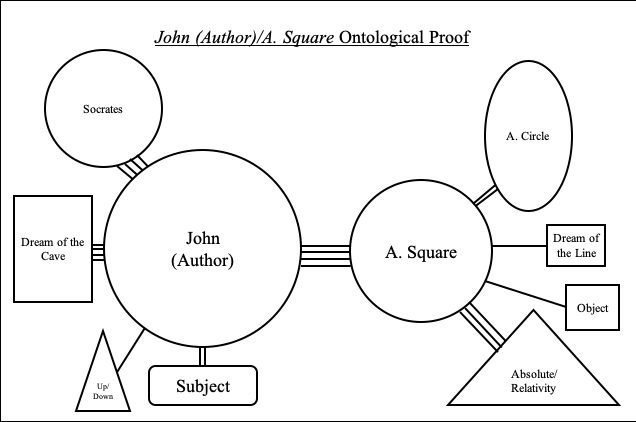
Figure 2
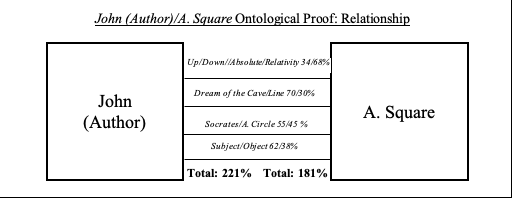
Figure 3
In a strictly pedagogical context, this is an ‘onto-phenomenal’ dialectical method, for reasons once again saved for another paper[4]. Applying an equally dialectical as logical IBL method may be effective in assisting students to meet the expectations of the Common Core for 8th grade in several ways. As Reading Standard 1 concerns citing textual evidence, via IBL, students are encouraged to consider the text in support of their arguments via the journey to more questioning. Similarly, where Reading Standard 10 concerns range, quality and complexity, the dialectical aspect of IBL prepares students to subconsciously compare concepts in relation to one another. Writing standard 1 emphasizes distinguishing between opposites, a fundamental component of any dialectical process, and Speaking and Listening Standard 1 necessitates ‘collaborative conversations with diverse partners’, without which IBL would become strictly logical, and so dependent upon Absolute ‘uncertainty’ via the evolution of conversation (which is rarely, if ever, fully ‘certain’). Between these four standards, the outlining influence of the dialectical aspects in IBL becomes temporally evident.
Conclusion
The evolution of IBL, from its foundations in the Socratic Method to its most recent logical expatiations, represents only one of several contemporary approaches to the teaching process. However, it’s a strategy which clearly exemplifies the differences between the logical and dialectical thinking/axiomatization so integral to navigating our modern, potentially post-logical age. In relation to the Danielson Framework, IBL utilizes methods pertaining to at least three components of Domain 3 and assists students in meeting the expectations of the Common Core via ‘spontaneous-as-proven’ (conscious/proof) conscious-subconscious conversation and subconscious-conscious self-reflection. I hope to utilize IBL in my own classroom via emphasizing not only the question-and-answer format it provides, but per its contained opportunity for the critical self-reflection and spontaneous-thought-evolution so integral to both academic and non-academic life, to ‘thinking’ in both logical and dialectical circumstance, and to the so-called ‘real world’, circa 2025.
Bibliography
Aristotle. (2001). The Basic Works of Aristotle (R. McKeon, Ed.). The Modern Library.
Chalmers, D. J. (1996). The Conscious Mind: In Search of a Theory of Conscious Experience. Oxford University Press.
Danielson, C. (2013). Danielson Framework for Teaching: Complete Narratives and Rubrics. Independently Published.
Hegel, G. W. F. (1977). Hegel’s Phenomenology of Spirit (A. V. Miller, Trans.). Oxford University Press.
Jung, Carl G. (1989). Collected Works of C.G. Jung, volume 14: Mysterium Coniunctionis. Collected Works of C. G. Jung (G. Adler & R. F. C. Hull, Trans.). Princeton University Press.
Magrini, J. M. (2013). Dialectic and Dialogue in Plato: Refuting the Model of Socrates-as-Teacher in the Pursuit of Authentic Paideia. Educational Philosophy and Theory, 46(12), 1320–1336. https://doi.org/10.1080/00131857.2013.817942
Melber, L. M., & Hunter, A. (2010a). Strategy 15: Establishing a Pluralist Approach to Content. Integrating Language Arts and Social Studies: 25 Strategies for K-8 Inquiry-Based Learning, 104–110. https://doi.org/10.4135/9781483349480.n15
Melber, L. M., & Hunter, A. (2010b). Strategy 20: Symbolism and Social Studies. Integrating Language Arts and Social Studies: 25 Strategies for K-8 Inquiry-Based Learning, 143–148. https://doi.org/10.4135/9781483349480.n20
Plato. (1961). Plato: The Collected Dialogues (E. Hamilton & H. Cairns, Eds.). Princeton University Press.
Small, R. (2018, June 15). The Roots of Vedanta in America. American Vedantist. https://americanvedantist.org/2018/articles/the-roots-of-vedanta-in-america/
Wolpert-Gawron, H. (2016, August 11). What the Heck is Inquiry-Based Learning?. Edutopia. https://www.edutopia.org/article/blog-what-heck-inquiry-based-learning-heather-wolpert-gawron/
[1] This is a bit of a loaded statement; the point is that a primarily dialectical approach to IBL would look very similar to one primarily logical, because consciousness only has one way of proving of itself, that being via symbolism/axiomatization/etc. Utilizing the dialectical approach would consist partly in recognizing the futile nature of Absolute contextual definition, and partly in the activation of ongoing subconscious (multi-dimensional, or at least post-three-dimensional) forces.
[2] As against the logical interest in language, dialectics takes a more grammatical approach, a point made by both Hegel and the Samkhya school of the Vedic tradition. For the present method: a ‘/’ between opposing concepts represents either the relation between the two concepts or the two concepts as hypothetically opposed, depending on the dimensional quality/quantity (for an example). As such, the order of the concepts with a ‘/’ does not matter. Conversely, concepts arranged with a ‘dash’ represent a dimensional discrepancy, the first listed concept being the outlining (relativizing) factor of the second.
[3] For a brief procedural explanation (and I’m hoping words in footnotes and figures don’t contribute to overall paper word-count): shapes represent varying degrees of dimensional relevance (squares one-dimensional forms, triangles two-dimensional relations, and circles three-dimensional ontologies, although this gets a little funky in more complicated proofs), lines are direct relations between directly related concepts, and the placement/size of shapes, lines, etc. represent varying degrees of dimensional complexity/simplicity. Proofs of concept (fig. 4) are intended to provide evidence for both the dialectical proof (fig. 2) and its three-dimensional relationship (fig. 3). The proof of concept in this example is mostly spontaneous and therefore generally abstract because this example is of a more therapeutic variety; other types of ‘proofs of concept’ could be much more scientifically-based (more rooted in logical progression), depending on the goal (say, comparing Aristotle understanding of quality vs. quantity, for example). I realize this isn’t directly related to the topic of this paper, but I figure it could help to show how IBL could be expanded in the future, and it’s always nice to make use of a hobby.
[4] Technically, the three figures above represent an ‘onto-phenomenal’ proof in the sense that they quantify both subjective and objective processes (as multi-dimensional– ‘ontologically phenomenal’, so to speak), where dialectical proofs outline concepts as singularity or as precursors to singularity.