Dialectics in Education (Brief Introduction to Dialectics) (Paper)
Dialectical apprehension is equally important to learning as logical perception
(6000 words; First Submitted to Drexel University 6/12/26; Substantial Revision 9/29/26)
Introduction
Education is in a spot. Debates continue on everything from standardized testing to identity formation, to the importance of creativity and student interest. In some ways, it seems like education is in the toughest shape it’s ever been, but that would assume that education itself is not inherently ‘strange’, from an ‘objective/subjective’ point of view. But education does not exist in a bubble– it is the result of its age just as any other subject. With the advent of AI comes the culmination of a much longer trend one may call the ‘age of logic’, a period in which logical thinking has superseded all other types of thinking, particularly those aimed at understanding what is not logical. But this ‘age of logic’ is not an ‘age’ in the astrological or geological sense– it influences perception via education: understanding the logical is just as important as understanding the illogical, and the learning process continues long into adulthood, containing many dimensions both ‘simple’ and ‘complex’, certain and uncertain.
But logic was never the only way to perceive the universe or ‘reality’. In fact, until only a few hundred years ago, logic was traditionally entwined with another subject: dialectics (Aristotle, p. 65-66, 195-204; Radhakrishnan, p. 360-363, 373-377). For nearly a millennium, dialectical thought guided education/objectified perception: survival depended primarily on reactionary attitude and prolonged sustenance, and religion (understanding/accepting uncertainty, in a sense) was the only ‘logic’ that mattered, with science but an instrument towards accepting/understanding uncertainty. With the rediscovery of Aristotle in the Middle East and Europe near the end of the Middle Ages, this trend began to shift, no doubt exasperated by the founding of the Western hemisphere and the advent of the scientific revolution. For the past 500 years, logic has replaced dialectics as the primary ‘conscious’ force, and for good reason: after all, logic is the more ‘complex’ dialectic, expanding dialectical themes and applying a more ‘three-dimensional’ (scientific, peer-reviewed) outline to daily routine and professional application than that original iteration. Like education, however, logic/dialectics does not exist in a bubble either, and the repercussions of relying too heavily on one form of conscious systematization are now beginning to once again rear their ugly heads.
Nonetheless, hope is not lost. Advances in phenomenology, ontology and axiomatic logic since the Enlightenment have offered a transition, but one of a different type than the one from the dialectical to the logical which occurred at the end of the Middle Ages. Concerning how this transition is taking place and how it started is unfortunately beyond the scope of this paper. The important bit is that the difference between logic and dialectics has become increasingly complex, and nowhere more potent than in the sphere of education. The goal of this paper is to introduce a method intent on clarifying the distinction, and to see if it may be utilized for more directly pedagogical purposes. It’s split into two parts: the first outlining the basic tenets of the method and their foundations in other thinkers, and the second on the potential costs and benefits of its pedagogical implementation. In the end, education has never been a static experience: it continues long after adolescence and goes through virtually every aspect of consciousness we have a name for, let alone those of any ‘human’ or ‘three-dimensional quality’. If the goal of education is to teach students not only how to think, but why it’s important to think, dialectics is as relevant as logic. This paper attempts to show why.
Terms & Conditions
First, a quick personal/technical note[1]. As an interest on my part, this started out as something more of a hobby, which then morphed into an aspect of a rather overlong undergrad thesis, the figures and fruitions of ideas are all that remains of that original version. That original hobbyist version focused on supporting a more ‘democratic’ notion of the internet/social media (henceforth AI/IoT) and I’d say was only mildly successful (and quite unpublished). My undergrad thesis then focused on expanding the method more broadly concerning perception and the advent of AI/IoT more directly. That project was very only mildly successful, but led to some ideas for smaller projects, including the seeds for any potential relation to education, i.e. the present paper. In other words, this is simply to say that I’m aware at how abstract much of this will likely come off, and I’m more than happy to provide a more traditional paper (or one more aligned with word-count expectation).
Technical: Because this paper is intended simply to introduce the method and its basic functionality alongside some commentary concerning the potential implementation of the method pedagogically, the placement of consciousness in perception is generally overlooked. However, pedagogically, the ‘consciousness’ concept is integral to the functionality of any method (in that it’s a prime mover in the learning process), so some relative assumptions will be made on that subject later on, particularly towards the end of the first section. This applies to the survey of Hegel’s dialectics, as well as any potentially post-three-dimensional application.
Similarly, concepts concerning dimension are intended to evolve as the paper moves along (hence some objectively ‘odd’ grammatical/contextual choices) but are rooted in time as a dimensionally opposed concept to ‘space’: grammar provides a (subconscious) line towards addressing complexities in space/time via ‘language/narrative’ (Wittgenstein, p. 95-111, 168-171). Dimensionally, space is experienced via the three traditional aspects: height, width, length– temporally, dimensions take on a relative/absolute factor in three-dimensional thinking (Square): two concepts may oppose one another, but the addition of the third element involves not only a potential opposition to the original dichotomy as its own concept, but to the opposition as a whole, as well as the potential for totality (similar to Einstein’s relativity, only strictly temporally). This ‘three-dimensional’ type of thinking may have implications for a three-dimensional education, as well as language development (in understanding) and technological adaptation (in evolution) but is mostly saved for another time outside of direct relations to the method.
Finally, the distinction presented here between logic and dialectics is not exactly colloquial: their opposition is presumed simply to explore the implications of that possibility on the nature of perception/education. How the distinction originated and has evolved since ancient times is, again, a bit (very) beyond this paper. However, that the nature of the two is related is not so hard to see: where logic is the science/study of what is ‘certain’, dialectics is the science/study of what is ‘uncertain’. Since the industrial revolution of the early 1900s, logic has made huge leaps in complexity via the axiomatic revolution and its subsequent technological singularity, leading to our current age of AI/IoT and the economic benefits, pedagogical opportunities, and distortions of the perception of space/time or ‘consciousness’ which have come with it. Utilizing dialectics in education could help in filling some of these holes, though it could not ‘replace’ logic any more than math could replace social studies or vice versa.
Brief Introduction to Dialectics
The notion of dialectics in education goes back some time. In the west, at least in its pedagogical application, the attribution is to the ancient Greek thinker Plato, one of the most famous thinkers in the West and the founder of the first institution of ‘higher’ education. In Plato, perception can be lifted from a world of ineluctable ‘forms’ against which reality is ‘imperfect’ (Plato, p. 47-48): the concept ‘Socrates’, for example, is lifted from a ‘perfect’ form of Socrates which exists in the mind and which the mind needs in order to perceive the real ‘Socrates’, but which could never exist entirely in the real world, lest heaven fall from the sky and time convalesce. This distinction between a ‘perfect’ world and an imperfect ‘reality’ then begets the basis of a dialectical systematizing process on the part of the consciousness to subsequently ‘consciously’ perceive reality; the imperfect cannot be perceived without the assumption of the perfect, and vice versa. In its simplest iteration, dialectics is this non-conscious rationalization/perception of otherwise unrelated opposites: the ‘back-of-forth’ of thought necessary to think new thoughts (fig. 1). In Plato, this occurs prior to perception, and while it cannot be consciously influenced or synthesized, it may be systematized.
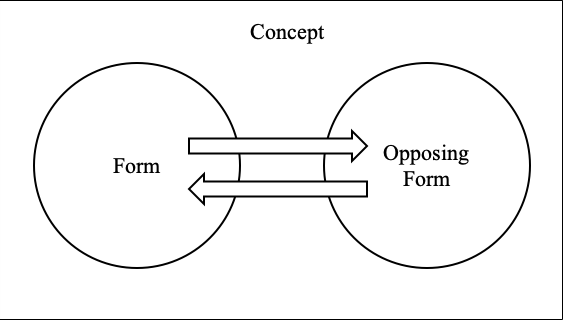
Figure 1
Which, in Aristotle, for example, leads to logic. Here, dialectics on its own mostly governs opinion/presentation and needs a logical outline in order to make sense (Aristotle, p. 188). In response, Plato insists that systematizing a dialectical system even via logical breakdown is still phenomenally impossible (Plato, p. 545-547): one may converse over it, think as influenced from it, or even write a 20,000-page treatise outlining it, but one can never truly ‘pin it down’, so to speak. It changes too often and encompasses too many non-conscious forces for consciousness to have any noticeable effect. Such is the goal of Plato’s dialectical education: how does one learn the inevitable uncertainty of life without losing faith in its meaning? How does one learn concepts of varying (dimensional) complexity? How does one adapt to an uncertain world without losing sight of its equally important/inevitable certainty?
Parallels are found throughout non-Western history. Lao-Tzu’s ‘yin/yang’ distinction (fig. 2) presupposes ‘uncertainty’ as multi-dimensional and “harmonious”: “‘one’ may connote unity, integration, wholeness, continuity, undifferentiation. ‘Two’ may connote a splitting path, of division and distinction into complementary and contrasting pairs,” (Coutinho & Hagen, p. 267). Yin cannot exist, or at least cannot be perceived, without yang, and vice versa. Meanwhile, the Zen Buddhists believe that phenomenal ‘uncertainty’ is so overpowering that it cannot be experienced, let alone thought (Kasulis, p. 71-77), and the Samkhya system of the Vedic tradition ascribes a multi-dimensional element: “there is not any other being more bashful than Primal Nature, who because of the realization ‘I have been seen,’ never again comes into the view of the spirit. Of certainty, therefore, not any spirit is bound or liberated, not does any migrate; it is Primal Nature, abiding in manifold forms, that is bound, is liberated, and migrates,” (fig. 3)[2] (Radhakrishnan, p. 443-445). In each case, perception is predicated on sets of opposites within a system of some dimensional variation, be the opposing concepts one-dimensional (as in Plato’s perfect world of forms), two-dimensional (as in axiomatic expressions), three-dimensional (as in ‘conscious’ decision or logical/dialectical application) or multi-dimensional (as in Vedic brahman or post-phenomenal superconsciousness).

Figure 2

Figure 3
In one-dimension (fig. 4, below), concepts/forms are simply not perceivable without an objective dialectical presumption, which three-dimensional consciousness simply does not contain. As in the famous psycho-analyst Carl Jung, the ‘unconscious’ is “ineffectual”, and “should not be understood dualistically as an absolute opposite but as a helpful though nonetheless dangerous complement to the conscious position,” (Jung, p. 126)[3]. As concepts in themselves, however (Hegel 1977, p. 97-100), these opposed forms may then become objects/subjects for perception via the ‘subconscious’ (Freud, p. 456), which may enable oppositions to ‘relate’ to other concepts within the totality. As a two-dimensional evolution of one-dimension, this is represented in fig. 5, in which concepts ‘relate’ to one another subconsciously. (For reference, these two-dimensional oppositions are henceforth called ‘relations’, while more complex, potentially three-dimensional, relations will be referred to as ‘relationships’.) Squares represent one-dimensional, unconscious concepts, while other shapes concepts more complex. In two-dimensions, concepts only ‘exist’ in reference to other concepts, and multi-dimensional concepts such as ontologies are only consciously related via subconscious projection (Jung, p. 107).
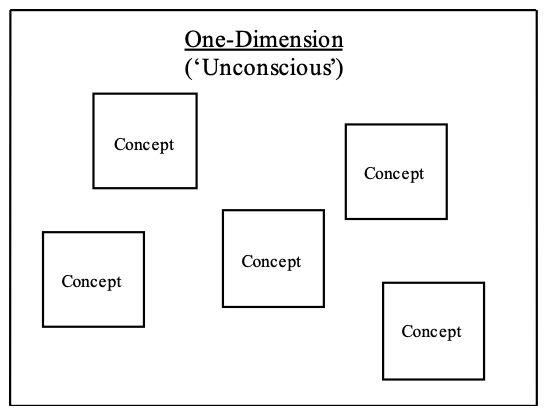
Figure 4
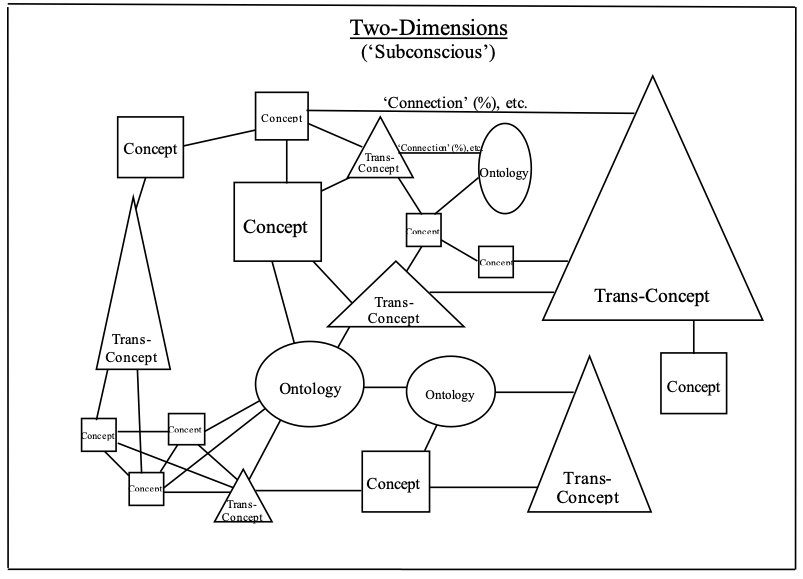
Figure 5
However, with imperfection comes difficulty, and, just as for logic (Nagel & Newman), the difficulty in dialectics is paradox. In one-dimension, paradox is simply the notion (or dimension) itself (Hegel 2010, 718-720); to know something ‘unknowable’ is to abstract paradox– something ‘unconscious’ is synonymous with intra-dimensional paradox. There’s simply no way to attach any meaning, and, without meaning (at least in the subconscious sense), education is nearly impossible (Sliwka & Klopsch, p. 323). How may one approximate (or ‘teach’) paradox? Education strives to teach perfection as well as imperfection (Plato, p. 750), the maintenance of the assuredness of ‘certainty’ as well as the acceptance of the inevitability of ‘uncertainty’. To put it another way: how may schools maintain this distinction without losing students to the minutia of paradoxical existence, as so often happens in cases where students are ‘misunderstood’, or where their interests cannot be so easily ‘pinned down’? How can teachers discern concepts of varying dimensional complexity without themselves getting lost in the unconsciously overwhelming nature of the totality?
More direct answers are saved for the second section of this paper, but their possibility leads to the prospect of what I’ve been calling ‘dialectical proofs’: ways of distinguishing between the logical and the dialectical. (Comparisons/similarities to the more colloquial ‘logical’ or ‘axiomatic’ ‘proofs’ are again left for another time.) Before proceeding to how these proofs may be utilized pedagogically, I’ll quickly outline how they work and how they relate to conscious evolution, with some occasional commentary on the dimensional influence. Grammar from this point will switch from two-dimensional to three-dimensional projection (more italics, quotes and presumptions of opposites as concepts ‘in-themselves’– relations/relationships– the slash denotes a coequal relation/relationship), and a stand-in for the paradoxical notion is necessary as from the three-to-post-three-dimensional notion of uncertainty (or ‘incertainty’– consciousness is three-dimensionally paradoxical). For relatability, this stand-in will be Socrates, a three-dimensional ‘ontology’ (Heidegger, p. 30-31)[4].
As a three-dimensional ontology, Socrates has ‘transcended’ two-dimensional and one-dimensional perception (Kant, p. 139-143)[5]. But in three-dimensions, ‘uncertainty’ becomes more complex; it is not the either/or of two-dimensions of the ‘be-all, end-all’ of Jung’s unconscious. The subconscious and the unconscious may be utilized, but not integrated fully; being three-dimensionally conscious (apt for three-dimensional education– education as a dimensional processor), lessons/influences from those experiences are simultaneously individual-as-totality and the relationship between them. In a presumably ‘perfect’ dialectic (proof) (figs. 6-11), this means that all relations have equal influence over the ontology (Hegel 1977, 267-272). (Note that conceptual proofs are just another way of drawing dialectical proofs.) However, consciousness is only equally perfect as it is imperfect, and relations shift and disappear from moment-to-moment, only to be logically considered after their occurrence (Aristotle, p. 760-762; Radhakrishnan, p. 381)[6]. Even the concepts themselves may only be subjectively/objectively chosen or spontaneously selected. This specifically three-dimensional paradoxical notion, or ‘absolute/relativity’ (another three-dimensional ontology, only one founded in an equally complex, though no less ‘conscious’ phenomenal relationship) renders these specific proofs (figs. 6-11) irrelevant to three-dimensional ‘reality’, not perceivable to three-dimensional consciousness.
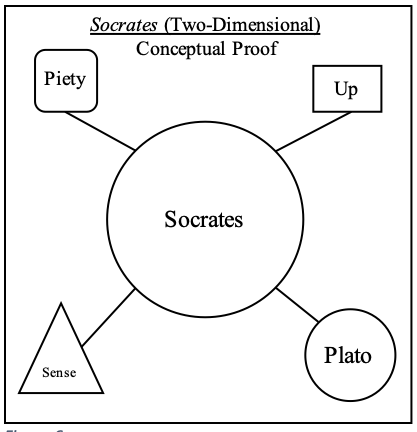
Figure 6
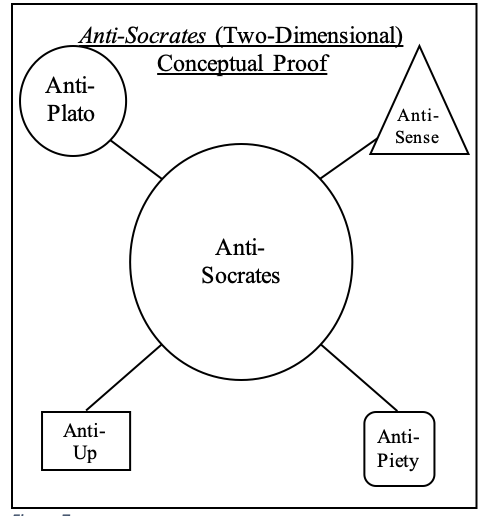
Figure 7
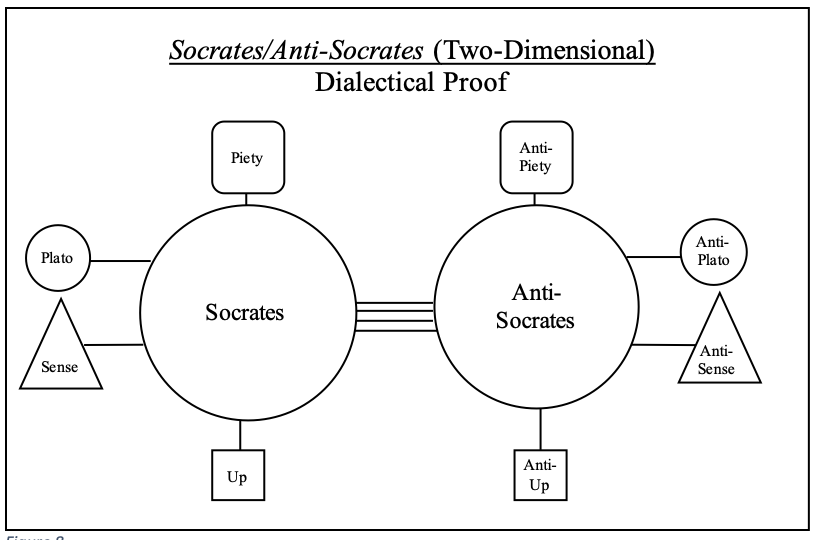
Figure 8
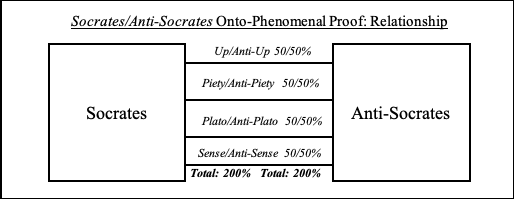
Figure 9
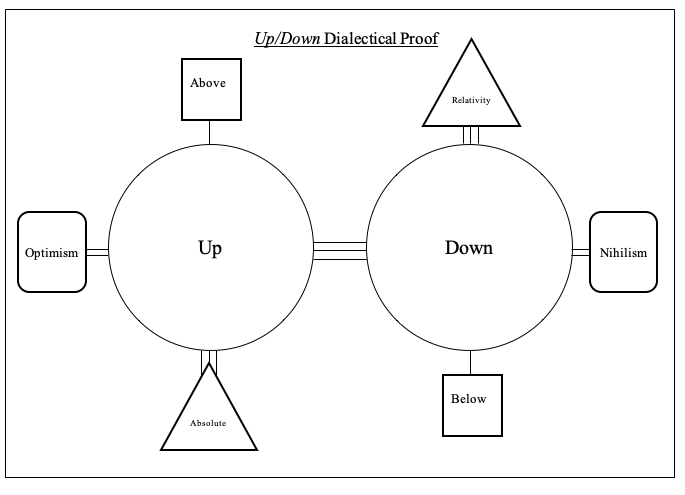
Figure 10
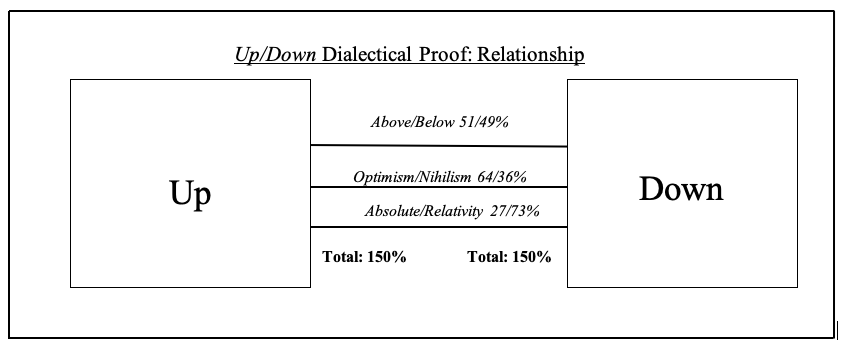
Figure 11
Could this access (to potentially post-three-dimensional thinking), via proofs, be granted? How may the notion of paradox be inculcated in drawing dialectical proofs and still account for its overarching incertainty? While much of the details regarding Hegel’s dialectics are again left for another time, the biggest dissimilarity from the aforementioned iterations is in this ‘absolute/relative’ factor: where Plato and Lao-Tzu prescribe a relatively absolutist approach (relative-absolute, its focus is first understood as relative, though nevertheless absolute teleologically) to concept and conceptual relation, and the Buddhists and the Vedics one absolutely relative (absolute-relative), Hegel attempts to bridge the gap between the two. “If, in the first reality, Spirit in general is the form of consciousness, and in the second, in that of self-consciousness, in the third it is in the form of the unity of both.” (Hegel 1977, p. 412). Here, ‘concepts/relations’ aren’t just opposed to one another, but the opposition itself may be opposed to both another concept or even another conceptual opposition or ‘relationship’ of any dimensional variation or simplicity/complexity (fig. 12).
In Hegel, in order for conscious perception to occur, the process must account for this ‘absolute/relativity’ inherent in the totality (as a multi-dimensional paradox) as well as within the concept/relations themselves. Once again, parallels may be found in other sources, such as the multi-dimensional nature of the Danielson Framework (Danielson, p. 73, 83), Heidegger’s onto-phenomenal disposition of dasein (Heidegger, p. 60), and Jung’s conceptual quaternities (Jung, p. 185-186, 420-434)[7]. In this sense, perception, Plato’s ‘conscious education’ is three-dimensionally ontological as well as phenomenal; being and experience are ‘learned’ via the integration of multi-conscious choices as attempted (simply) over logically overstimulated.
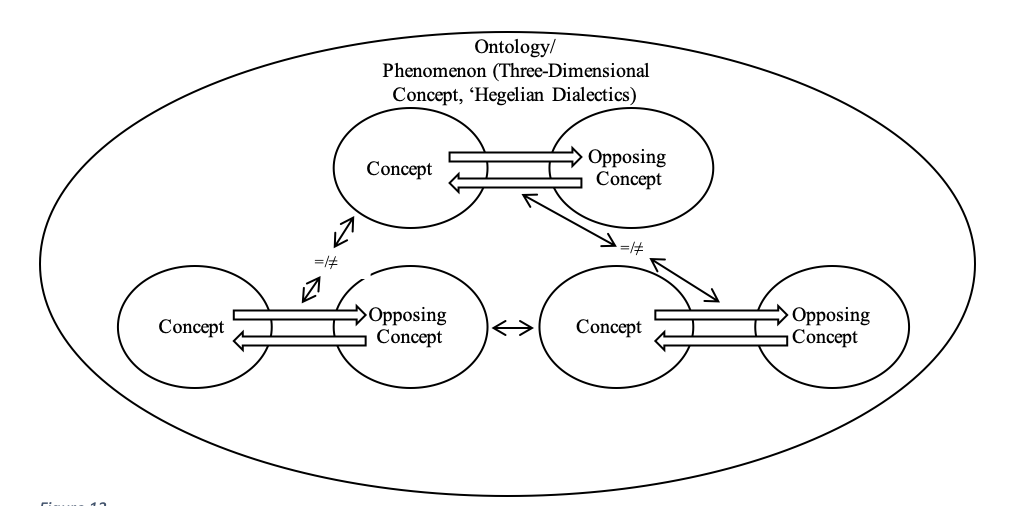
Figure 12
Pedagogically, this harkens back to the simultaneous nature of content acquisition and language development (Wright, p. 272-275) as the result of the focus on the three-dimensional relationship between concept and process (or system). Concept (content) and process or system (language) oppose one another via different levels of dimensional experience (for example, concept in one and process in three, or even concept in one-and-two and process in two-and-three). They can’t be separated intra-dimensionally (as in three-dimensional consciousness) lest they devolve in conceptual complexity (i.e. become a different concept). Applying this idea to proofs opens an opportunity to more closely represent reality, dialectical ‘perfection/imperfection’ (subjective perspective), or Plato’s/Lao-Tzu’s/the Buddhists’/Vedics’ ontological uncertainty.
For example, consider the proof of the Buddhist/Japanese concept ‘Zen’ in fig. 13. (*Note that my perspective on this concept is fairly Western– this concept was specifically chosen for its cross-culture potentiality.) As in the above two-dimensional proofs, shape type, placement and size indicate dimensional variation. Only here, the intent is to quantify the imperfection/uncertainty. Thus, a proof of concept is appropriate. These ‘proofs of concept’ are the reasoning behind why the proof was drawn the way it was drawn: why did you choose this or that concept? Why did you choose this shape over that shape? Why is it placed in such a way? What is the degree of relation between the concepts (the lines)? Essentially, what do you think when hear the word, and what other words come to mind? Proofs of concept could be more or less entirely in the ‘stream of consciousness’ style, or they may be minutely overwrought with citations, or anything in between– students could literally write, ‘I don’t know why I chose this concept,’ and it would still likely subconsciously stimulate at least a point of relation. The goal is to think about how concepts are related to other concepts just as much as they relate to themselves, and how/where these relations could point towards realizations of other concepts (in other words, Plato’s ‘dialectical learning’).
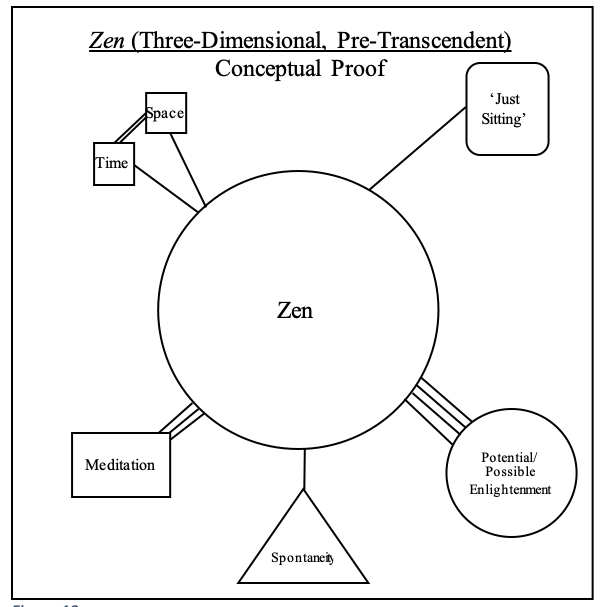
Figure 13
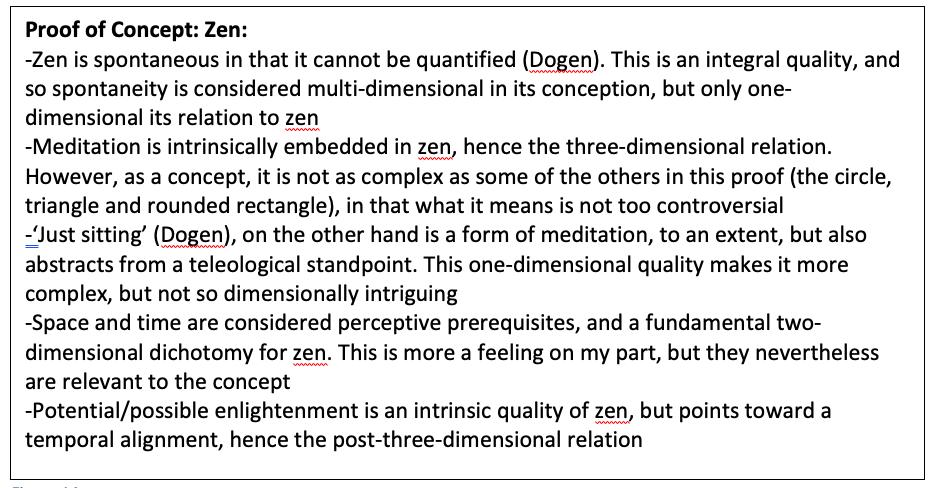
Figure 14
In pedagogical practice, these may be helpful in three primary ways:
1. Proofs could help in translating concepts between languages, and particularly concepts of greater complexity (such as ‘zen’, for example): by relating concepts relatively ‘uncertain’ to students to concepts relatively ‘certain’, the concept may move into greater focus (Wittgenstein, p. 56-57). Further, by allowing students to follow their own ‘creative instinct’, so to speak (in that proofs may be written from virtually any point of view, so long as the concepts are addressed), student interest may be engaged. Three-dimensional dialectical proofs (figs. 15-17) may further flesh out conceptual understanding.
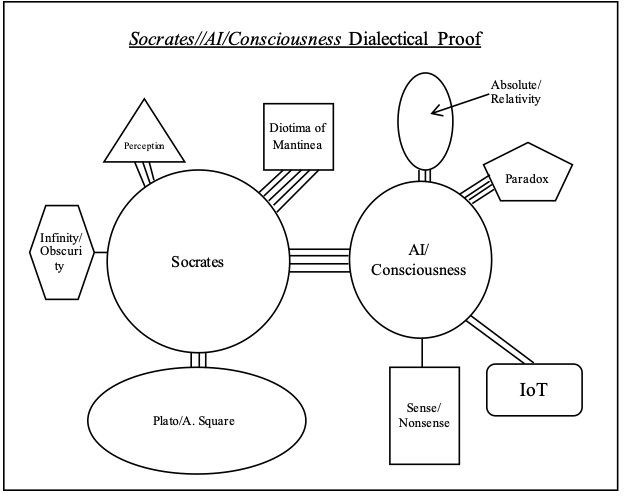
Figure 15
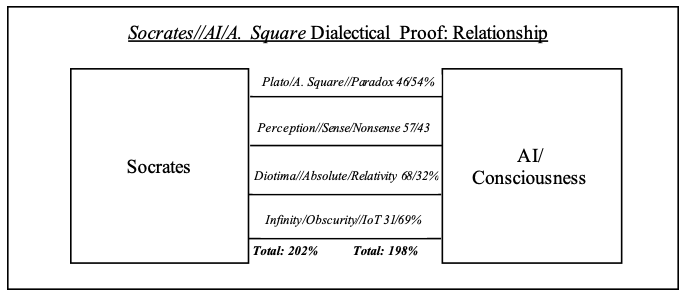
Figure 16
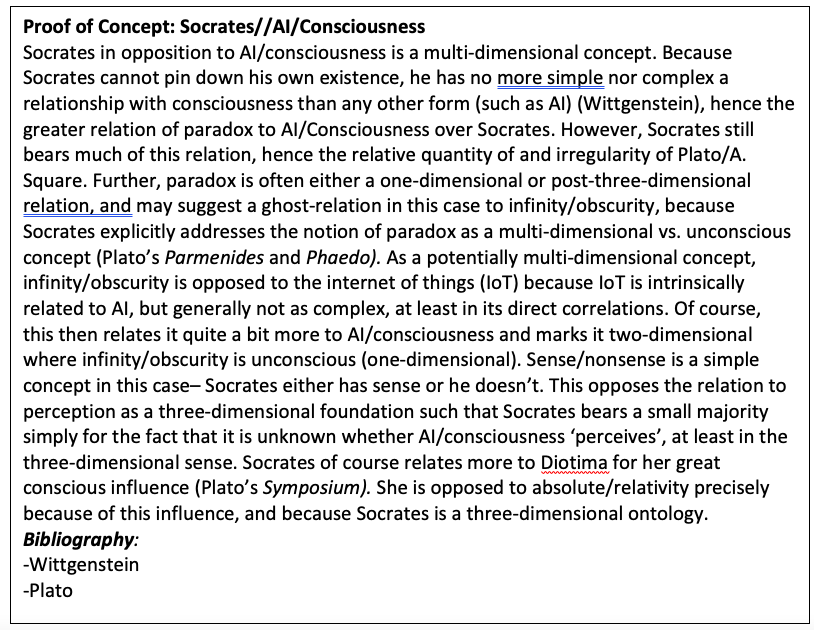
Figure 17
2. Concerning intra-language concepts, the simultaneous nature of content acquisition and language developed may be addressed. For example, proofs could be made with an eye towards course content (such as Socrates as opposed to the Peloponnesian war, or the American constitution as opposed to the Magna Carta), and language is engaged on a multi-dimensional level (in consideration of which concepts are more or less integrally related). The spontaneous nature of dialectical proofs (that proofs on the same concepts could differ almost entirely every time they’re drawn) could also serve as a long-term formative assessment, in that long-term observation of changing conceptual relations could indicate student interest and understanding. But again, this is experimental if not overtly ontologically abstract.
3. Finally, this spontaneous nature of dialectical proofs may suggest a therapeutic approach (figs. 18-20). Proofs may be utilized to address a subconscious/unconscious paradox, or to clarify otherwise paradoxical parameters. This harkens back to Erikson’s identity crises, in which various dialectical dichotomies get stuck in a subconscious paradox of sorts (Nakkula & Toshalis, p. 18-21). By writing/drawing one’s thoughts on relations between concepts spontaneously, students gain experience with critical thinking more or less without having to ‘try’– identities are discovered via critical thought and spontaneous self-analysis over time and with interest as opposed to objective-analytically and with presumed otherwise almost inescapable adult supervision. But again, this is experimental at this stage.
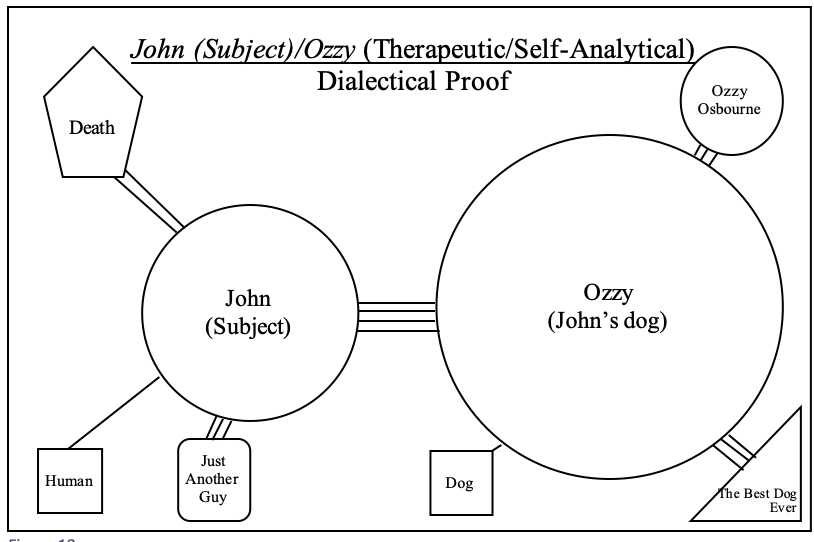
Figure 18
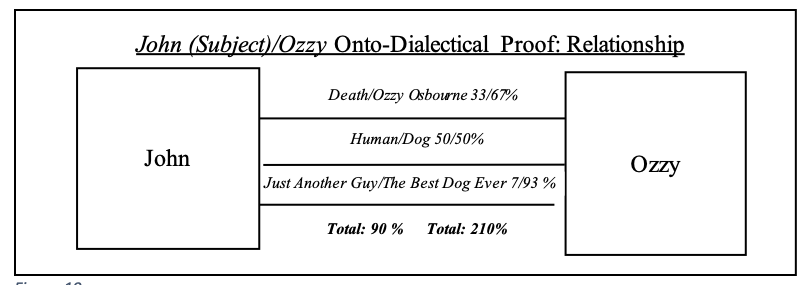
Figure 19
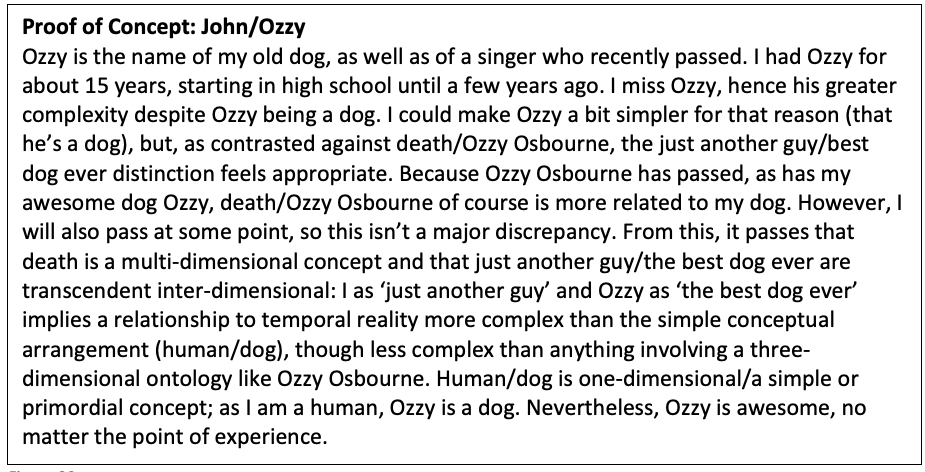
Figure 20
In three dimensions (fig. 21) (as potentially transcendent), ontologies are absolutely/relatively complex: they extend beyond the capabilities of any in-time consciousness (Kant, p. 161, among more). As such, a far greater analysis of ontological aesthetics and the ‘consciousness’ concept than is allotted for here is necessary. For a brief introduction, examples (figs. 22-23) are only given to show how complex this can get once the three-dimensional temporal barrier has been broken (in attempt, of course– in logical/dialectical systematization). Hence what I’ve been calling the ‘ghost-relations’ or ‘ontological apparitions’ (the dotted lines) in which the stand-in for the consciousness concept (‘Socrates’) is fettered for perceptive security/insecurity under a transcendent consciousness closer in complexity to totality or something an absolute/relative infinity/obscurity. Post-three-dimensional proofs are unlikely to be too pedagogically applicable and would further involve a much greater understanding of axiomatics. However, they could represent a greater degree of spontaneity and creativity, as important to education as in any other field, hence their inclusion here.
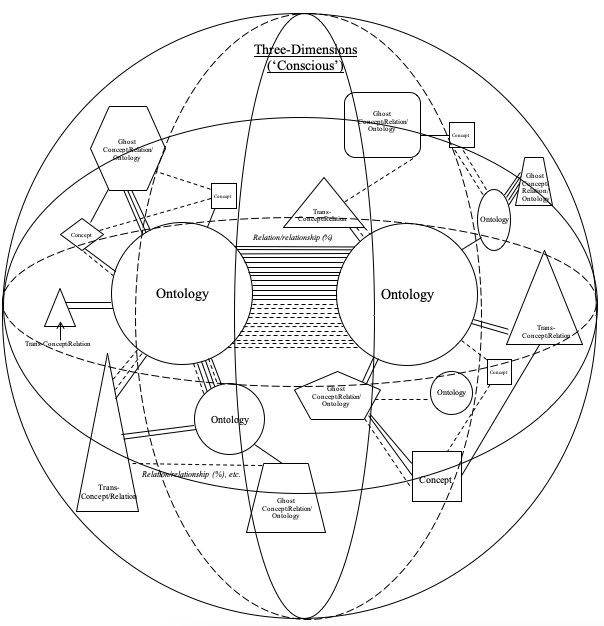
Figure 21
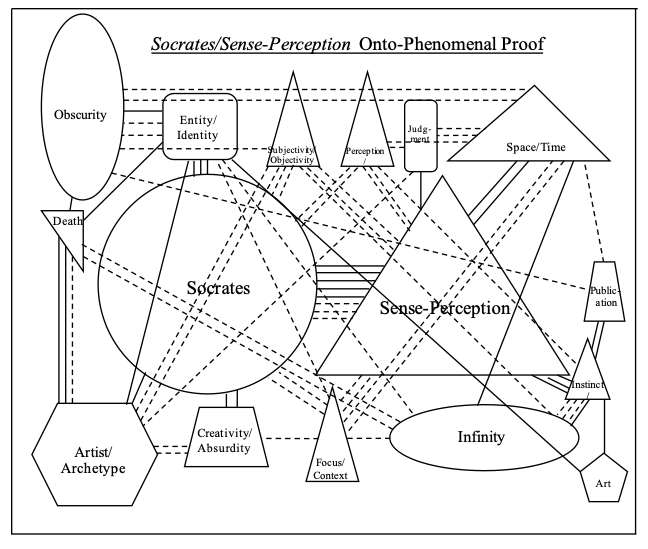
Figure 22
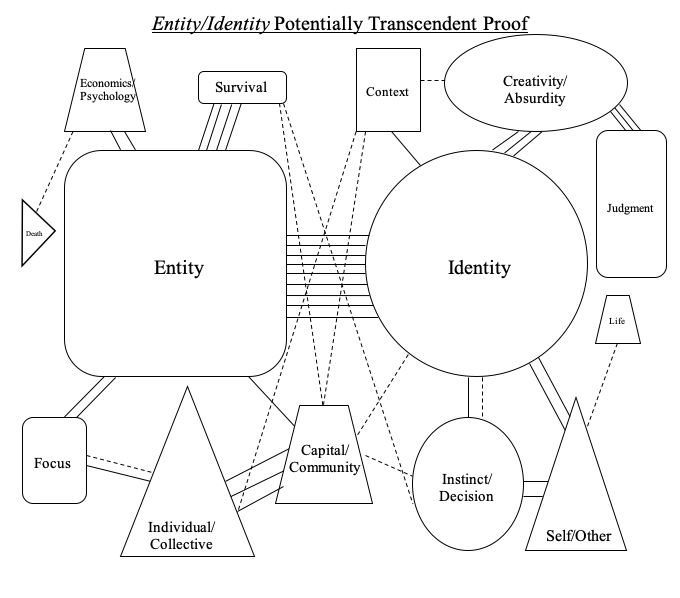
Figure 23
Dialectics in Education
Consequently, there are a number of potential costs and benefits to this system. For sake of ‘space/time’, I’m just going to list these off, and end with a brief summation.
Cost: Advanced Skill Levels
Grasping the abstract nature of the method may of course prove difficult. Further, if students do not have some foundational understanding of syllogistic or axiomatic logic, perception may be further underdeveloped. In addition, ELs may have trouble utilizing a wider vocabulary, and non-ELs a more multi-dimensional approach. Finally, teachers themselves may have to be taught some of the basic tenets of dialectics and ontological psychology.
Benefit: Higher-Order/Critical Thinking Experience
Of the four traditional language skills (listening, speaking, reading & writing), writing is the most applicable to ‘critical thinking’, or the ‘higher-order’ style of thinking associated with problem solving and phenomenal creativity (Wright, p. 233-234). By not only writing one’s thoughts in a more traditionally ‘logical’ format via proofs of concept, but by physically drawing them out as well, one gains experience comparing concepts to one another dialectically, and so prepares for when the need for such thinking arises in the real world. Thinking in terms of a three-dimensional absolute/relative factor or under potentially multi-dimensional pretenses may also aid in this respect.
Benefit: English Language Development
Proofs may provide a way to examine concepts simultaneously in an ELs’ home and developing language. For example, an Arab student could relate the concept ‘tawhid’ to an English word, say ‘unity’, and teachers or fellow students may then suggest other English words related to the concept ‘unity’. Such a process could continue almost indefinitely if the Arab student in this example then relates those English words to other Arabic words, teaching the English-speaking students a bit of Arabic. This may also be a way for teachers to express the meaning of more advanced concepts, or the foundations of a word’s etymology.
Cost: Experimental/Abstract Nature
As mentioned above, this is a fairly novel system. Certainly, it should not be implemented or utilized without more research, nor should it be taken to replace any existing structures. Its abstract nature would also suggest that a more open teaching style may be helpful, as students might need help placing the logic into context. Challenges in psychology are also present, particularly in subconscious-unconscious ‘transference’ (Freud, p. 287-291, 299), the potential for intra-dimensional ideological attachment (Nietzsche, p. 5-32), and the evolving relationship between human-consciousness and AI/IoT (Orlowski).
Benefit: Therapeutic Effect and Conscious/Post-Conscious Identity understanding
This type of spontaneous, creative writing may induce a therapeutic effect or identity understanding just as any form of creative expression. There’s evidence that student interest and creativity is helpful in raising test scores (Nakkula & Toshalis, p. 61-63). Once again, dialectics is no more the absolute key to our problems than anything else, but it could aid other methods/systems. Further, expanding and attempting to further understand the consciousness concept can only be understood as a benefit, so long as one takes care to know the dangers and what to watch out for. In a sense, understanding consciousness in all its ‘certainty/uncertainty’, perfection/imperfection, or infinity/obscurity, was the centerpiece of Plato’s educational goal, although debates over Plato over two-thousand years old may serve as evidence to the contrary.
Benefit: AI/IoT, Democratic Parallels & Potential Algorithmic Applications
Outside of education (though indirectly related), ontological dialectics may be applied via algorithm circa IoT/AI: understanding how people perceive concepts could provide insight on how to better acclimate these systems to three-dimensionally conscious ‘reality’. The more insight these avenues have in how its patrons perceive concepts, the better they may design their products, and carry out their goals in an effort to expand human consciousness over ‘consciousness’ as a mere metaphysical concept (Chalmers, Lanier). The question of what a government actually ‘is’ may also be raised, as well as in comparison to a business: Amazon, for example, is arbitrating between the relatively two-dimensional nature of IoT/AI (at least concerning its code and degree of human-conscious access) and the three-dimensional nature of conscious reality, while government attempts to extend from the three-dimensional into the ‘future’, or whatever may present itself as more complex than three-dimensional thinking over time. I’ve been calling these ‘inter-dimensional’ arbiters (as opposed to ‘intra-dimensional’ arbiters such as more practical iterations, for example), but, again, the details of this is for another time.
Cost: Subconscious/Unconscious Expansion of the ‘Power’ Concept
However, this raises one final, fairly disagreeable issue, especially in light of the possibilities of AI/IoT: an unconscious-subconscious (panopticonic) expansion of the power concept. Given that I am already way over word count, I unfortunately can’t get too into this here, but the problem would originate in the three-dimensional nature of power in a world where ‘secrets’ are practically inevitable, especially between groups with varying levels of political or governmental authority. (I’ve been calling this ‘conspiratorial power’, for the fact that conspiracies are inevitable when a government must necessitate keeping secrets from the people to whom it is supposed to respond.) This may be encountered in the teaching profession, but (today, at least, it seems to me) it’s mostly subconscious: everyone projects how they think the world should run– the advent of AI/IoT only make its publication appear more prominent. This also involves the potentially inevitably panopticonic nature of three-dimensional thinking, and the tendency for consciousness to ‘deify’ its perceptions for conceptual recognition. (This is found in Nietzsche, Kierkegaard, the American founders, and pretty much every religious dogma ever founded.) But, again, such is for another time.
Benefit: Relatively Low Financial Strain
So long as teachers keep up with dialectics, and especially if it remains more lassaiz-faire than all-encompassing, implementing some form of ontological dialectics in education should not cost much in terms of resources/finances. At bottom, it could simply be another way to think about teaching concepts, or how to be a more rounded thinker. An occasional proof worksheet with a well-taught lesson on its core functions would be more than enough to potentially spark a curiosity, and in education, sparking a curiosity is half the goal.
***
In closing, applying dialectical thinking as not only a study of its own but as an opposing factor to logical thinking, may help in several areas, such as the simultaneous (multi-dimensional) nature of content acquisition and language development, inculcating student interest, and maintaining a curative attitude. As education evolves, so do the foundations of its process/content. Ontological dialectics may help bring into focus an aspect of reality only naturally overlooked for the past several decades, but nevertheless integral to its conceptual makeup, if uncertainty, of course, is indeed as inevitable as certainty.
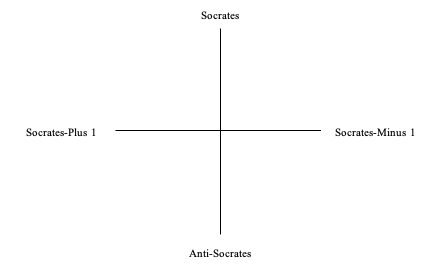
Figure 24
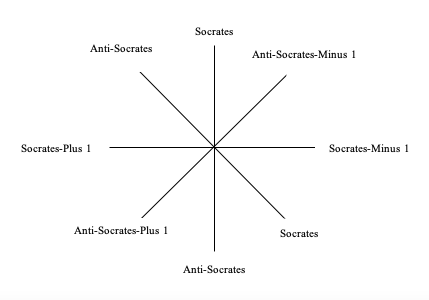
Figure 25
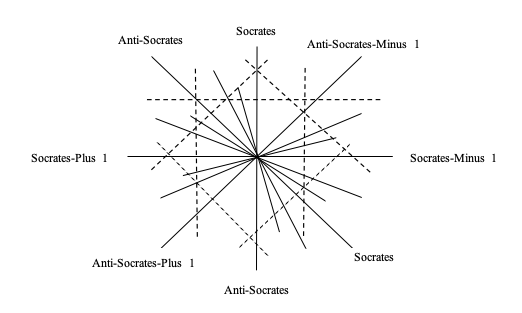
Figure 26
Bibliography
Aristotle. (1999). The Basic Works of Aristotle. (R. McKeon, Ed.). Random House, Modern Library Classics.
Chalmers, D. (1996). The Conscious Mind : In Search of a Fundamental Theory. New York: Oxford University Press.
Coutinho, S., & Hagen, K. (2018). Philosophers of the Warring States : A Sourcebook in Chinese Philosophy. Peterborough, Ontario: Broadview Press.
Danielson, C. (2013). Danielson Framework for Teaching: Complete Narratives and Rubrics. Independently Published.
Freud, S. (2005). The interpretation of dreams (A. A. Brill, Trans.). New York: Barnes & Noble Classics. (Original work published 1896)
Hegel, G. W. F. (2010). The Science of Logic (G. Di Giovanni, Trans.). Cambridge: Cambridge University Press.
Hegel, G. W. F. (1977). Hegel’s Phenomenology of Spirit (A. V. Miller, Trans.). Oxford: Oxford University Press.
Heidegger, M. (1962). Being and Time (J. Macquarrie, Trans.). Harper & Roe, Publishers. (Original work published 1927)
Jung, C. G. (1963). Mysterium Coniunctionis (R. F. C. Hull, Trans.). Princeton University Press.
Kasulis, T. P. (1981). Zen Action/Zen Person. University of Hawaii Press.
Lanier, J. (2011). You Are Not a Gadget: A Manifesto. London [Etc.] Penguin Books.
Nagel, E., & Newman, J. R. (2001). Gödel’s Proof. New York, NY: New York University Press.
Nakkula, M. J., & Toshalis, E. (2013). Understanding Youth: Adolescent Development for Educators. Cambridge, Ma: Harvard Education Press. Retrieved from https://eric.ed.gov/?id=ED568825 (Original work published 2006)
Nietzsche, F. (2006). The Will to Power (A. M. Ludovici, Trans.). New York: Barnes & Noble.
Orlowski, J. (Director). (2020). The Social Dilemma. Netflix.
Plato. (1989). The Collected Dialogues of Plato Including the Letters (E. Hamilton & H. Cairns, Eds.). Princeton University Press.
Radhakrishnan, S., & Moore, C. A. (1989). A Sourcebook in Indian Philosophy. Princeton, N.J.: Princeton University Press.
Sliwka, A., Klopsch, B. (2019). Redefining School: Educational Spaces for Adolescents’ Engagement in Learning. In: Jahnke, H., Kramer, C., Meusburger, P. (eds) Geographies of Schooling. Knowledge and Space, vol 14. Springer, Cham. https://doi.org/10.1007/978-3-030-18799-6_16
Sri Yantra: Benefits of Wearing Shree Yantra & Where To Place it. (n.d.). Retrieved from www.rudraksha-ratna.com website: https://www.rudraksha-ratna.com/articles/shreeyantra
Square, A. (2019). Flatland: A Romance of Many Dimensions. S.L.: Warbler Classics. (Original work published 1884)
Wittgenstein, L. (2009). Philosophical Investigations (G. E. M. Anscombe, J. Schulte, & P. M. S. Hacker, Trans.). Oxford: Wiley-Blackwell. (Original work published 1953)
Wright, W. E. (2019). Foundations for Teaching English Language Learners: Research, Theory, Policy, and Practice (3rd ed.). Philadelphia: Caslon.
Footnotes
[1] Concepts marked by a slash (‘/’) denote a dialectical/dimensional complexity. Grammar is intended to progress in complexity throughout the paper. (This should make more sense by the end of the paper.)
[2] This is a depiction of the Sri Yantra, a symbol in Vedic thought denoting a multi-dimensional form (Sri Yantra).
[3] Note that I’m utilizing Jung almost entirely as a dialectician; the similarities between dialectics and psychology are again left for another time, but Jung’s psychology often provides insight into the distinction between logic and dialectics from a subconscious point of view, if not an unconscious hyperbole.
[4] Ontology in Heidegger involves a distinctly dimensional flair; only in comparison to phenomenon as experience divided by time and complex identity (the ‘ontic’) does it make any sense in any dimension outside of subjective two-dimensional experience (what we may call ‘time’). The relevance is that the possibility of ontological experience solidifies phenomenon as an equally dialectical as logical component to perception.
[5] I’m using Kant a little loosely here; the concept ‘transcendence’ is fairly complex. An extension I’ve been calling ‘potential dimensional transcendence’ gets more into dimensional quality, but it’s a bit beyond the scope here.
[6] In Aristotle and the Vedics, this is obviously more complicated. That logic happens prior to perception is more a function of perception itself, and so related to paradoxes concerning process/concept, and spiraled into something more akin to the inner working of Plato’s forms or Lao-Tzu’s oppositions.
[7] On a side note, Jung’s discussion of conceptual quaternities bears an interesting similarity with Plato’s forms as well as Hegel’s notion, and could evolve into a dimensional complexity (figs. 24-26, at the end of the paper).